兵临城下
Chinese team develops intelligent vision sensor that turns light signals into AI-ready tokens, reducing use of energy_我的网站

一 |
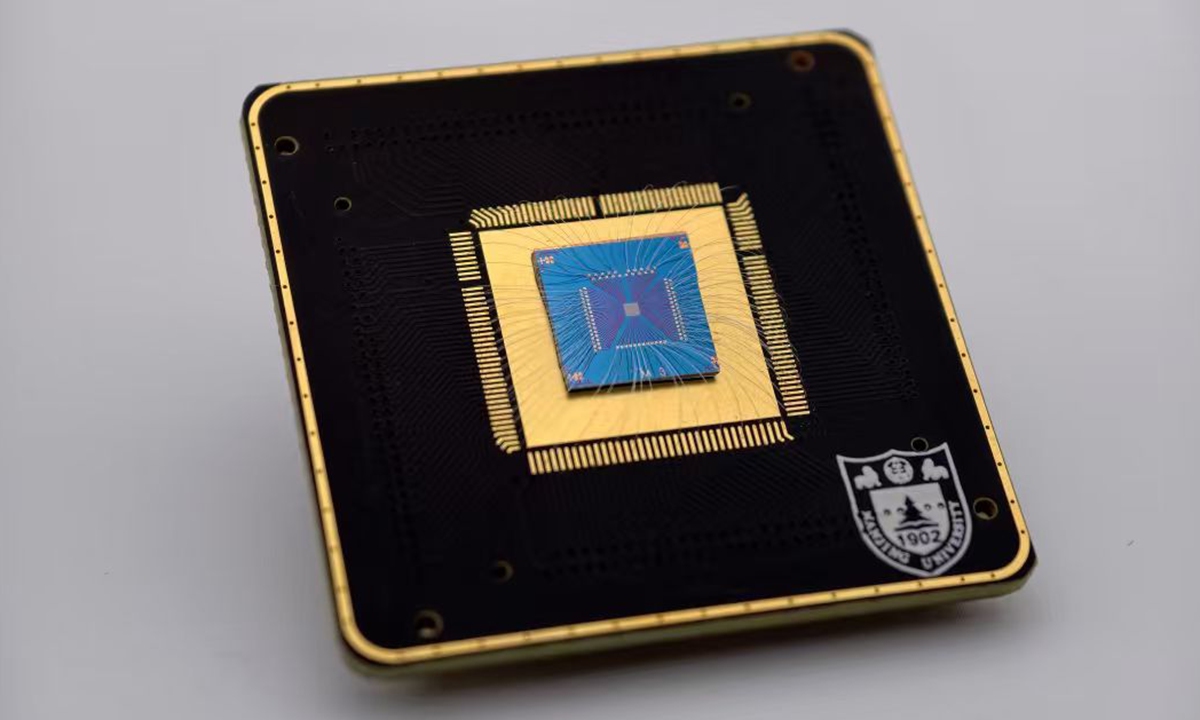
The new ultra-low-power intelligent vision sensor chip "LightTok" developed by a research team from Nanjing University. Photo: from Science and Technology Daily
A Chinese research team from Nanjing University has developed a new ultra-low-power intelligent vision sensor chip, dubbed "LightTok," that can convert light signals into tokens within the sensor, significantly reducing the high energy consumption caused by frequent transfers of massive amounts of redundant data, the principal investigator told the Global Times.
According to a release from the Institute of Brain-Inspired Intelligence of Nanjing University, tokens generated by the LightTok chip can be directly fed into a Transformer encoder for image recognition.
"Our design idea was to move token generation onto the sensor itself, allowing the chip to directly produce tokens that AI models can process once light reaches the sensor," Miao Feng, director of the Institute of Brain-Inspired Intelligence at Nanjing University, told the Global Times on Thursday. "These tokens contain complete image information."
Physical AI refers to intelligent systems capable of autonomously perceiving, reasoning, acting and receiving feedback in the real world, representing a key pathway for AI to move from the digital realm into the physical world. Vision-based physical AI systems powered by large AI models need to convert visual information from real-world environments into tokens that can be processed by AI models before feeding these tokens into Transformers for subsequent tasks.
In traditional visual perception pipelines, light signals must go through multiple stages, including image sensing, analog-to-digital conversion, data buffering and transfer, digital image patching and embedding, before being transformed into tokens that AI models can process. The frequent transfer of massive amounts of redundant data has resulted in high energy consumption at the edge, according to a report by Science and Technology Daily.
The LightTok chip directly addresses a key challenge in physical AI hardware: how to efficiently acquire and tokenize visual information from the physical world with low energy consumption, Miao said.
The LightTok chip consists of a photosensitive memory array and peripheral circuits. The team built the array based on single-layer molybdenum disulfide (MoS₂) floating-gate phototransistors, with each pixel capable of sensing light, storing information and performing analog computing. By processing optical information directly within the chip, the device can convert captured visual signals into tokens for AI models, according to the research team.
The current LightTok prototype has a resolution of 32×32 pixels, or 1,024 photosensitive pixels, which is still smaller than that of smartphone cameras and industrial imaging systems. However, Miao said the technology is compatible with CMOS manufacturing processes and can be scaled up. With wafer-level growth of molybdenum disulfide materials, the chip could potentially achieve a scale comparable to existing imaging devices.
Miao said the chip also draws inspiration from the information-processing mechanism of human vision. Similar to how the retina extracts key visual information before transmitting it to the brain, the chip also aims to process visual information at an early stage.
The research was conducted in collaboration with another research team from the National University of Singapore. The findings were published on Wednesday in Nature Sensors, an internationally renowned journal in the field of sensing technology, according to the release.
Potential applications for LightTok include drone systems, autonomous remote sensing and small-scale embodied AI systems, Miao said. In these scenarios, devices need to continuously detect, understand and track targets, generating massive amounts of visual data. By reducing the energy required for visual processing, the technology could extend the operating time of drones, satellites and small robots with limited power supplies, the expert said.
。 8 月 26 日消息,理想汽车今日发布 2026 财年(2026 年 1 月~2026 年 12 月)上半年(2026 年 1 月~2026 年 6 月)报告:营业总收入:486.5 亿元,同比下降 13.4%毛利润:46.44 亿元,同比下降 59.2%毛利率:9.5%归母净利润:-39.94 亿元,同比由盈转亏经营现金流:-60.76 亿元基本每股收益:-1.98 元稀释每股收益:-1.98 元资产负债率:53.1%AI 解读本次理想汽车 2026 财年上半年业绩低于市场一致预期,营收和归母净利润均出现同比下滑,阶段性亏损幅度扩大。

二 | 财报核心亮点新车交付量达到 193472 辆,在人民币 20 万元以上中国新能源汽车市场,以 12.1% 的市占率稳居中国汽车品牌销量榜首,累计交付量达到 1733687 辆实现营业收入 486.5 亿元,同比下降 13.4%归母净利润为 -39.94 亿元,去年同期为盈利 17.43 亿元毛利润为 46.44 亿元,同比下降 59.2%,毛利率为 9.5%,同比下降 10.8% 个百分点基本每股亏损 -1.98 元,稀释每股亏损 -1.98 元业务进展产品层面:2026 年上半年先后发布全新理想 L9 和全新理想 L8,两款车型均标配 72.7 度 5C 电池、理想汽车第三代增程器、高通骁龙 8797 芯片,理想 L9 Ultra 和理想 L9 Livis 售价分别为 45.98 万元和 50.98 万元,理想 L8 Ultra 和理想 L8 Livis 售价分别为 36.98 万元和 42.98 万元,分别于 2026 年 5 月和 6 月开启交付;7 月发布新一代理想 L6 并开启交付,售价为 24.98 万元。

三 | 研发层面:自研芯片马赫 M100 和马赫 VLA 模型成功实现一体化量产上车,马赫 M100 单芯片算力达到 1280TOPS,算力利用率超 80%,相比上一代架构提升一倍,实现全链路自主突破;语言模型和大模型方面推出马赫 Mind-Pro 和马赫 Mind-Edge,在智能座舱端实现技术落地。渠道网络:截至 2026 年 6 月 30 日,在 160 个城市拥有 495 家零售中心,在 220 个城市运营 536 家售后维修中心;全国已有 4097 座理想超充站投入使用,配备 22593 根充电枪。

四 | 海外拓展:2026 年 4 月签约阿联酋、沙特阿拉伯头部经销商,6 月正式进入澳门市场,稳步推进国际化布局。未来展望2026 年下半年,除现有纯电产品矩阵迭代外,计划 9 月发布全新纯电旗舰 SUV 理想 i9,进一步完善纯电产品矩阵;全新理想 L9 在 7 月先后登陆哈萨克斯坦与乌兹别克斯坦,哈萨克斯坦本地化生产启动后,将持续推进国际化布局;未来将坚持以具身智能为核心战略,依托软硬件一体的全栈自研与持续迭代,为用户创造更多价值产品。相关阅读:风险提示:本文内容由 AI 自动分析生成,仅供参考,不代表观点。如有出入请以证监会指定上市公司信息披露平台为准。

五 | 本文内容不构成投资建议,如有投资者据此操作,风险自担,对此不承担任何责任。
Current article:http://47rajw2.wenwancaomohenenqiongpangshun.bond/pv7t/a4pb.html
Published on:02:48:11